Autism Genetics: What the Latest Advances Really Mean for Individuals and Families
 From “Is there an autism gene?” to a more precise understanding of brain development
When parents hear that autism has a strong genetic basis, the first questions are usually:
“Which gene caused it?”
“Did it come from the mother or the father?”
“Will our next child also have autism?”
“Can a genetic test confirm autism?”
“Can the result tell us what the child’s future will be?”
These are understandable questions. Unfortunately, autism genetics cannot usually be explained through a single gene, a single inheritance pattern or a simple positive-or-negative test.
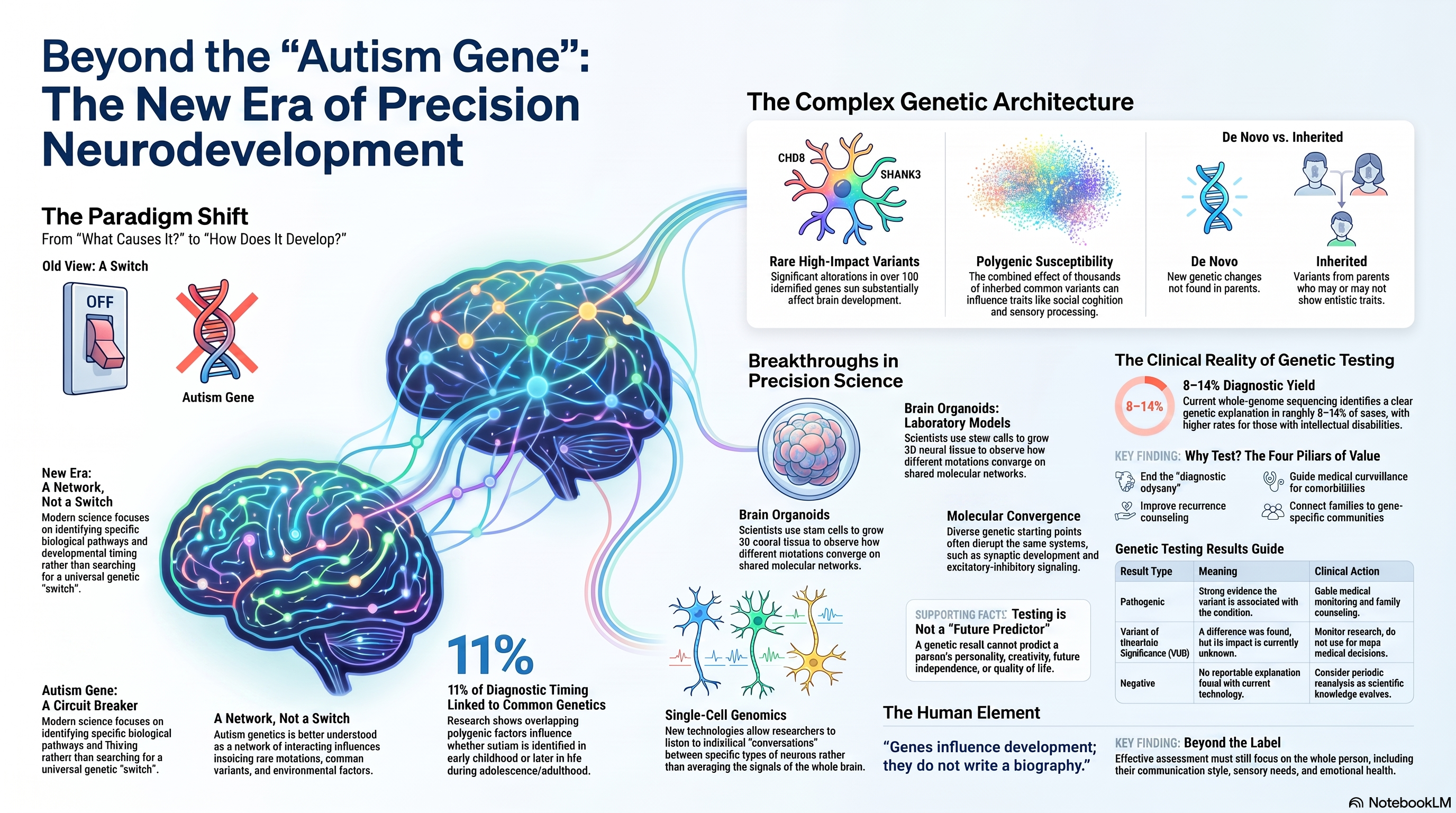
The major scientific advance is not the discovery of one autism gene. It is the recognition that the word autism includes many different developmental pathways that can eventually produce overlapping differences in social communication, sensory processing, behaviour, learning and adaptation.
As of July 2026, genetics is helping researchers move from asking:
“What causes autism?”
towards more useful questions:
“Which biological pathway is affected in this particular person?”
“At what stage of brain development did the difference arise?”
“Which associated medical problems should we watch for?”
“Can treatment and support become more individualised?”
There is no single “autism gene”
Autism has an exceptionally complex genetic architecture.
Researchers have identified more than 100 genes in which rare, high-impact mutations are strongly associated with autism, while hundreds of additional genes and genomic regions may contribute to risk. At the same time, much of inherited genetic susceptibility appears to arise from the combined effect of numerous common genetic variants, each contributing only a very small amount individually.
This means that autism may arise through several broad genetic routes.
Rare high-impact variants
A significant alteration in one gene may substantially affect brain development. Examples of well-established autism-associated genes include CHD8, SCN2A, SHANK3, SYNGAP1, ADNP, ARID1B, PTEN and MECP2, although the clinical consequences differ considerably between genes and even between people carrying variants in the same gene.
Copy-number and structural variants
A section of DNA may be missing, duplicated, inverted or rearranged. Regions such as 16p11.2, 15q11–13 and 22q11.2 can involve several genes and produce variable developmental, behavioural and medical features.
Polygenic susceptibility
A person may inherit thousands of common variants from both parents. None is sufficient to “cause autism,” but their combined effect may influence communication, social cognition, attention, sensory processing and other developmental traits.
Mixed genetic architecture
A rare variant may occur against a background of additional common inherited susceptibility. The person’s presentation may therefore reflect the combined effect of the major variant, polygenic background, sex, development and other biological or environmental influences.
Autism genetics is therefore better understood as a network of interacting influences than as a single faulty switch.
Autism is increasingly being understood as a collection of biologically different developmental pathways
The word spectrum is often imagined as a straight line from “mild” to “severe.”
Real autism is more complex.
One individual may have fluent language but substantial sensory distress and social exhaustion. Another may have intellectual disability, epilepsy and minimal spoken communication. A third may manage well in early childhood but struggle when social and academic demands increase during adolescence.
A major 2025 study analysed 239 clinical and developmental features in 5,392 autistic individuals and identified four data-derived groups:
- Broadly affected
- Social and behavioural challenges
- Autism with developmental delay
- Moderate challenges
The researchers found that these groups differed not only clinically but also in their patterns of common, inherited and de novo genetic variation. However, these are research-derived groupings—not new diagnostic categories to be routinely assigned in clinics.
Particularly important was the difference between de novo and inherited genetic contributions.
The broadly affected group showed the greatest enrichment of high-impact de novo variants. The autism-with-developmental-delay group showed a combination of de novo and rare inherited variants. Other groups had different patterns, suggesting that people who meet the same behavioural diagnostic criteria may have reached that presentation through different biological routes.
This research moves autism science away from searching for one universal cause.
The future may involve identifying a person’s:
- Developmental profile
- Genetic architecture
- Cognitive strengths and weaknesses
- Medical comorbidities
- Language and adaptive functioning
- Specific support requirements
The goal is not to divide people into rigid boxes. It is to understand why the same diagnosis can look so different in different individuals.
The timing of diagnosis may partly reflect different genetic and developmental profiles
Another important 2025 study examined why some autistic people are identified very early, while others receive a diagnosis only during adolescence or adulthood.
The researchers found that common genetic variation accounted for approximately 11% of differences in the age at which autism was diagnosed. They identified two overlapping polygenic factors.
One was associated with earlier diagnosis and more evident social-communication differences during early childhood. The other was associated with later diagnosis, greater socioemotional and behavioural difficulties during adolescence and stronger genetic overlap with ADHD and other mental-health conditions.
This does not mean that genes alone decide when someone receives a diagnosis.
Access to services, parental awareness, clinician experience, sex-related presentation, masking, culture, language and social expectations remain important. The study itself emphasised that much of the variation in diagnostic timing remains unexplained.
But it helps explain an important clinical reality:
Later-diagnosed autism may not simply be a milder version of early-diagnosed autism.
Some people may have a genuinely different developmental trajectory. Their differences become more apparent only when the social world becomes more complex—during secondary school, university, employment, marriage or parenthood.
This is particularly relevant to people who reach adulthood with diagnoses such as anxiety, depression, ADHD, obsessive-compulsive disorder or personality difficulties before the underlying autistic pattern is recognised.
Rare variants and common variants are no longer viewed as competing explanations
Earlier research often separated autism into two simplified categories:
- Autism produced by a rare mutation
- Autism produced by the cumulative effect of common variants
Current research suggests that these genetic influences can operate together.
A rare high-impact variant may strongly alter neurodevelopment. However, the final presentation can still be modified by the person’s wider genetic background.
This may help explain why two children with the same genetic syndrome can differ considerably in:
- Language development
- Intelligence
- Epilepsy risk
- Behaviour
- Motor skills
- Emotional regulation
- Independence
The presence of a particular mutation does not determine every aspect of the person.
Genes influence development; they do not write a complete and unchangeable biography.
What does “de novo” mean?
A de novo variant is a genetic change detected in the child but not found in the blood DNA of either parent.
It may have arisen in the egg, sperm or during very early development.
A de novo result does not mean that either parent did something to cause it. It is not caused by parenting style, emotional stress, vaccination or failure during pregnancy.
It is also important to understand that “not detected in the parents’ blood” does not always mean zero recurrence risk. Rarely, a parent can have the variant in a proportion of egg or sperm cells without it being detected in a routine blood sample. This is one reason recurrence counselling should be personalised rather than based on a general internet percentage.
What does an inherited variant mean?
An inherited variant may come from a parent who:
- Has obvious similar traits
- Has subtle or compensated traits
- Has a different clinical presentation
- Does not meet criteria for autism
- Is apparently unaffected
This is possible because many variants show variable expression and incomplete penetrance.
A genetic variant can increase probability without guaranteeing a particular outcome. The same variant can produce different effects depending on other genes, biological sex, development and wider context.
Therefore, finding that a variant was inherited from a healthy parent does not automatically prove that the result is harmless.
Equally, inheritance does not make either parent responsible for the child’s difficulties.
Genetic science is moving beyond the exome
The exome consists mainly of the portions of genes that provide instructions for making proteins. It represents only a small fraction of the total genome, but many known disease-causing variants occur there.
Whole-exome sequencing has therefore been extremely useful in neurodevelopmental conditions.
However, exome testing can miss important changes outside protein-coding regions.
The non-coding genome
Much of the genome helps regulate:
- When a gene is switched on
- Where it is expressed
- How strongly it is expressed
- Which form of a protein is produced
- How genes interact during development
Research has identified rare autism-associated variation in evolutionarily conserved non-coding regions. Other studies have shown that the effect of a regulatory variant may depend on the three-dimensional organisation of DNA and whether it alters communication between an enhancer and its target gene.
In simple terms, the gene itself may be intact, but the instruction controlling the gene may be altered.
Structural variants
Conventional short-read sequencing reads DNA in many short fragments. This works well for numerous small variants but may struggle with:
- Large inversions
- Complex rearrangements
- Repeated sequences
- Certain insertions and deletions
- Some forms of mosaicism
Long-read sequencing reads much longer stretches of DNA and may reveal structural changes that traditional testing misses.
A 2025 Indian study used long-read whole-genome sequencing in 23 children with non-syndromic autism whose previous karyotyping, Fragile X analysis, chromosomal microarray and short-read exome sequencing had not provided an explanation. The investigators identified a candidate 2.7-megabase inversion involving the SNAP25-AS1 region in one case. The authors appropriately described the contribution as modest and highlighted the study’s small sample size and technical limitations.
This study is important not because it has solved unexplained autism, but because it demonstrates that Indian genomic research is beginning to explore classes of variation that conventional testing may miss.
Long-read sequencing is promising, but it is not yet necessary or clinically interpretable for every autistic person.
Brain organoids are helping scientists understand what autism-associated genes actually do
Finding a gene is only the beginning.
Researchers must then ask:
- Which brain cells are affected?
- At what stage of development?
- Which molecular pathway changes?
- Do different genes eventually disrupt the same biological system?
It is not possible to directly study the developing brain of a child. Scientists are therefore using induced pluripotent stem cells.
A person’s skin or blood cells can be reprogrammed into stem-like cells and developed into three-dimensional neural tissue called a brain organoid. An organoid is not a miniature conscious brain. It is a laboratory model containing developing neural cells organised in ways that reproduce limited aspects of early human brain development.
A major Nature study published in January 2026 generated cortical organoids from 70 carefully quality-controlled stem-cell lines representing eight autism-associated mutations, idiopathic autism and unaffected controls.
The researchers found that different mutations produced distinct molecular changes early in development, but some of these changes converged onto shared gene-regulatory networks as development progressed. CRISPR-based experiments were then used to test some of the predicted regulatory mechanisms.
This provides a possible explanation for a longstanding puzzle:
How can alterations in many different genes eventually produce overlapping autistic features?
Different genetic starting points may disrupt shared developmental systems involving:
- Gene regulation
- Chromatin organisation
- Neuronal differentiation
- Synaptic development
- Excitatory and inhibitory signalling
- Communication between developing neural cells
This concept of molecular convergence may eventually be more therapeutically useful than studying each gene in isolation.
Single-cell genomics is revealing which cells are vulnerable
A brain sample contains many cell types mixed together.
Traditional genetic-expression studies average these signals, much like trying to understand every conversation in a crowded hall by listening to the combined noise.
Single-cell and single-nucleus technologies allow researchers to study individual types of neurons and supporting cells separately.
Large-scale organoid screening has shown that autism-associated genetic disruptions do not affect every developing cell equally. Vulnerability has been observed in cell populations such as dorsal and ventral neural progenitors and developing upper-layer excitatory neurons.
The 2025 subtype study also found that genetic variants associated with different clinical groups showed different developmental expression patterns. Variants in the autism-with-developmental-delay group were more strongly associated with genes expressed during fetal and neonatal stages, while the social-behavioural group showed enrichment in genes expressed later in development.
Emerging single-cell methylation research is adding another layer by examining chemical marks that regulate gene activity within specific brain-cell populations. These findings remain primarily mechanistic research and should not be mistaken for a clinically validated blood test for autism.
Genetics is beginning to explain why autism often overlaps with other conditions
Autism frequently co-occurs with:
- ADHD
- Intellectual disability
- Language disorder
- Epilepsy
- Sleep disorders
- Anxiety and depression
- Motor-coordination difficulties
- Gastrointestinal and feeding problems
Genetic studies increasingly suggest that diagnostic categories do not have completely separate biological boundaries. Some genes and polygenic influences affect broad aspects of neurodevelopment and may increase the probability of more than one clinical condition.
This does not mean that autism, ADHD and intellectual disability are identical.
It means that the brain does not necessarily follow the boundaries created by diagnostic manuals.
For clinical practice, this supports comprehensive assessment rather than stopping once the word autism has been assigned.
A useful evaluation should also examine:
- Attention and executive functioning
- Language
- Intellectual ability
- Adaptive skills
- Sleep
- Emotional health
- Epilepsy
- Motor and sensory functioning
The genetic result may explain part of the biology, but it does not replace this functional assessment.
What genetic testing can offer today
Genetic testing does not usually diagnose autism itself.
Autism remains a clinical and developmental diagnosis, based on the person’s history, behaviour, communication, sensory experiences and functioning.
Genetic testing asks a different question:
“Can we identify an underlying genetic explanation for this person’s neurodevelopmental presentation?”
In a 2024 SPARK study involving 21,532 autistic individuals, clinically returnable pathogenic or likely pathogenic findings were identified in 8.6%. These included single-gene variants, copy-number changes and chromosomal abnormalities.
Whole-genome sequencing studies commonly report yields in the approximate range of 8–14% in autism cohorts, with higher yields among people who also have intellectual disability, congenital abnormalities or other medically complex features.
A genetic explanation may provide several benefits.
It may end a long diagnostic search
Families may finally understand that the child’s developmental differences are not the result of poor parenting, inadequate effort or something that happened after birth.
It may guide medical surveillance
Certain genetic conditions carry elevated risks of:
- Epilepsy
- Cardiac problems
- Renal abnormalities
- Abnormal growth
- Tumours
- Movement disorders
- Sleep or feeding difficulties
Identifying the condition may lead to more focused medical monitoring.
It can improve recurrence counselling
Recurrence risk differs substantially between a de novo variant, a dominantly inherited condition, an autosomal-recessive condition, an X-linked condition and an unexplained multifactorial presentation.
It may connect families to relevant communities
Gene-specific family organisations and research networks can provide information, peer support and opportunities to participate in natural-history studies or clinical trials.
It may affect treatment in selected genetic syndromes
For a small number of genetic conditions, understanding the molecular pathway can influence clinical management. However, most genetic findings do not yet lead to a gene-specific medication.
The value of a result may therefore lie in explanation, surveillance, counselling and anticipatory care—not necessarily in an immediate new treatment.
Which genetic test should be considered?
There is no universal test sequence suitable for every person.
Possible investigations include:
- Chromosomal microarray
- Fragile X testing
- Targeted testing for a suspected syndrome
- Gene panels
- Whole-exome sequencing
- Whole-genome sequencing
- Parental or trio testing
- Mitochondrial testing in selected presentations
- Long-read sequencing in specialised circumstances
Test selection depends on the person’s age, physical examination, developmental profile, intellectual functioning, neurological findings, family history and previous investigations.
Exome or genome sequencing is already recommended early in the evaluation of children with intellectual disability, global developmental delay or congenital anomalies. The American College of Medical Genetics and Genomics has also been developing a specific evidence-based guideline on next-generation sequencing for autism, illustrating how rapidly this area is evolving.
Genetic counselling before and after testing is valuable because families need to understand what the test may reveal—and what it cannot answer.
Understanding the possible results
Pathogenic or likely pathogenic result
The laboratory has strong evidence that the variant is associated with disease.
Even then, the result may not predict the exact level of language, intelligence, behaviour or independence.
Variant of uncertain significance
A genetic difference has been identified, but current evidence is insufficient to determine whether it contributed to the person’s presentation.
A VUS is not a confirmed diagnosis.
It should generally not be used alone to make major treatment or reproductive decisions. Evidence may change as more families are studied.
Negative result
No currently reportable explanation was found.
This does not mean that the person’s autism is “not genetic.” The relevant variant may be:
- Outside the region tested
- Technically difficult to detect
- In a gene not yet confidently linked to autism
- Polygenic rather than monogenic
- A complex combination of inherited and de novo effects
A negative genomic test is not necessarily the end of the investigation. Periodic reanalysis may identify an answer later as scientific knowledge improves.
Polygenic risk scores: scientifically interesting, but not a diagnostic autism test
Polygenic risk scores combine information from numerous common variants into a statistical estimate.
They are useful in research for studying groups and genetic overlap between traits. However, an autism polygenic score cannot currently tell an individual:
- Whether they are autistic
- Whether a future child will be autistic
- How much support a child will need
- Whether language or intelligence will be affected
- Which treatment will work
Polygenic scores are sensitive to the population in which they were developed, and their accuracy may be poorer in people from underrepresented ancestries. Professional guidance continues to emphasise the limitations, communication challenges and need for careful validation before clinical use.
Commercial claims offering definitive autism prediction from polygenic scores should therefore be approached cautiously.
Can autism be predicted before birth?
There is no single prenatal genetic test that can determine whether a fetus will or will not be autistic.
Prenatal testing may identify a specific chromosomal or genetic condition associated with an increased probability of autism or developmental disability. But the same genetic finding can produce a wide range of outcomes.
It cannot reliably predict the future person’s:
- Personality
- Communication style
- Intellectual functioning
- Relationships
- Talents
- Quality of life
- Support needs
Attempting to use complex polygenic scores for embryo selection introduces major limitations and ethical concerns. ACMG has issued a specific cautionary statement regarding the clinical utility of polygenic risk scores for embryo selection.
Genetics must be used to improve understanding and care—not to make simplistic judgements about which forms of human neurodevelopment are valuable.
Why India needs its own autism-genetics research
Many major genomic datasets have disproportionately represented people of European ancestry.
This creates practical problems.
A variant that appears rare in a European reference database may be relatively common and harmless in an Indian population. Conversely, clinically important Indian variants may be underrepresented in international databases.
Limited ancestry representation can increase:
- Uncertain findings
- Misclassification
- Reduced polygenic-score accuracy
- Difficulty interpreting rare inherited variants
Indian research, family-based sequencing and population-specific reference databases are therefore essential. The 2025 Indian long-read study is an early example of this direction, but far larger and more diverse studies are needed.
India’s diversity also means that a single “Indian genetic reference” will not be sufficient. Population history, ancestry, endogamy and regional variation must be taken into account carefully and ethically.
Will genetics lead to personalised treatment?
That is the long-term hope—but precision medicine in autism is still at an early stage.
The most realistic pathway is not likely to be one medication that “treats autism.”
Instead, genetics may help identify subgroups in which a particular biological mechanism is disrupted, such as:
- Ion-channel function
- Synaptic signalling
- Protein synthesis
- Chromatin regulation
- mTOR signalling
- Excitatory–inhibitory balance
- Neuronal development
Researchers can then study whether modifying that pathway improves particular clinically meaningful difficulties.
Brain organoids, CRISPR editing, single-cell genomics and large natural-history studies are making this process more systematic. The 2026 organoid study is especially important because it demonstrated that different autism-associated mutations can converge on common molecular networks, potentially creating therapeutic targets shared across more than one genetic condition.
However, laboratory correction of a cellular pathway is not the same as improving communication, independence or quality of life in a person.
Any future treatment must demonstrate meaningful benefit and acceptable safety in human clinical trials.
Genetics should not make us forget the person
A genetic report may contain the name of a gene, chromosome or molecular pathway.
But it cannot measure:
- Affection
- Humour
- Creativity
- Curiosity
- Loyalty
- Determination
- Special interests
- Family relationships
- Personal values
- Future potential
A diagnosis may explain why certain situations are difficult. It should never become the entire identity of the person.
The best use of autism genetics is not to search for someone to blame or to reduce a person to molecular abnormalities.
It is to provide:
- A clearer explanation
- Appropriate medical surveillance
- Better counselling
- More personalised developmental support
- Access to relevant research
- Recognition of both strengths and difficulties
The practical message for families
The latest science gives us several clear conclusions.
Autism is strongly influenced by genetics, but there is no single autism gene.
Some cases involve a major identifiable genetic change; many involve complex combinations of common and rare variants.
A genetic test does not replace a careful clinical autism assessment.
A positive result may guide medical care and family counselling, but it usually cannot predict the person’s exact future.
A negative result does not rule out a genetic contribution.
Polygenic scores and prenatal prediction of autism are not ready for routine individual decision-making.
The future lies in combining genetics with developmental history, cognitive assessment, medical evaluation and real-world functioning.
The most important advance is therefore not simply that scientists are finding more genes.
It is that autism is being understood with greater precision—and, hopefully, with greater humility.
About the Author
Dr. Srinivas Rajkumar T
MD Psychiatry — AIIMS, New Delhi
Senior Consultant Psychiatrist
Mind & Memory Clinic
Apollo Clinic, Velachery, Chennai
Opposite Phoenix Marketcity
At Mind & Memory Clinic, autism assessment is approached comprehensively. The purpose is not merely to assign a diagnostic label, but to understand developmental history, communication, sensory needs, attention, emotional health, cognitive strengths, adaptive functioning and relevant medical or genetic concerns.
Genetic testing, when clinically appropriate, should be interpreted alongside a detailed developmental and psychiatric evaluation and, where required, consultation with a clinical geneticist or genetic counsellor.